
What is a clinical observership?
A clinical observership is an educational experience in which a visiting healthcare professional observes clinical practice, workflows, meetings, patient pathways or departmental organisation under the rules of the host institution. The purpose is exposure and learning, not independent clinical practice.
The exact definition can vary between institutions. Some observerships are centred on ward rounds and multidisciplinary meetings; others focus on operating-room observation, diagnostic workflow, outpatient processes, hospital management or technology. The host institution determines where the observer may be present and what activities are permitted.
What an observership is not
An observership should not be marketed as a shortcut to clinical licensing or as permission to treat patients. Visiting professionals may be highly experienced in their home country, but professional registration, patient safety rules, liability requirements and host policies still apply.
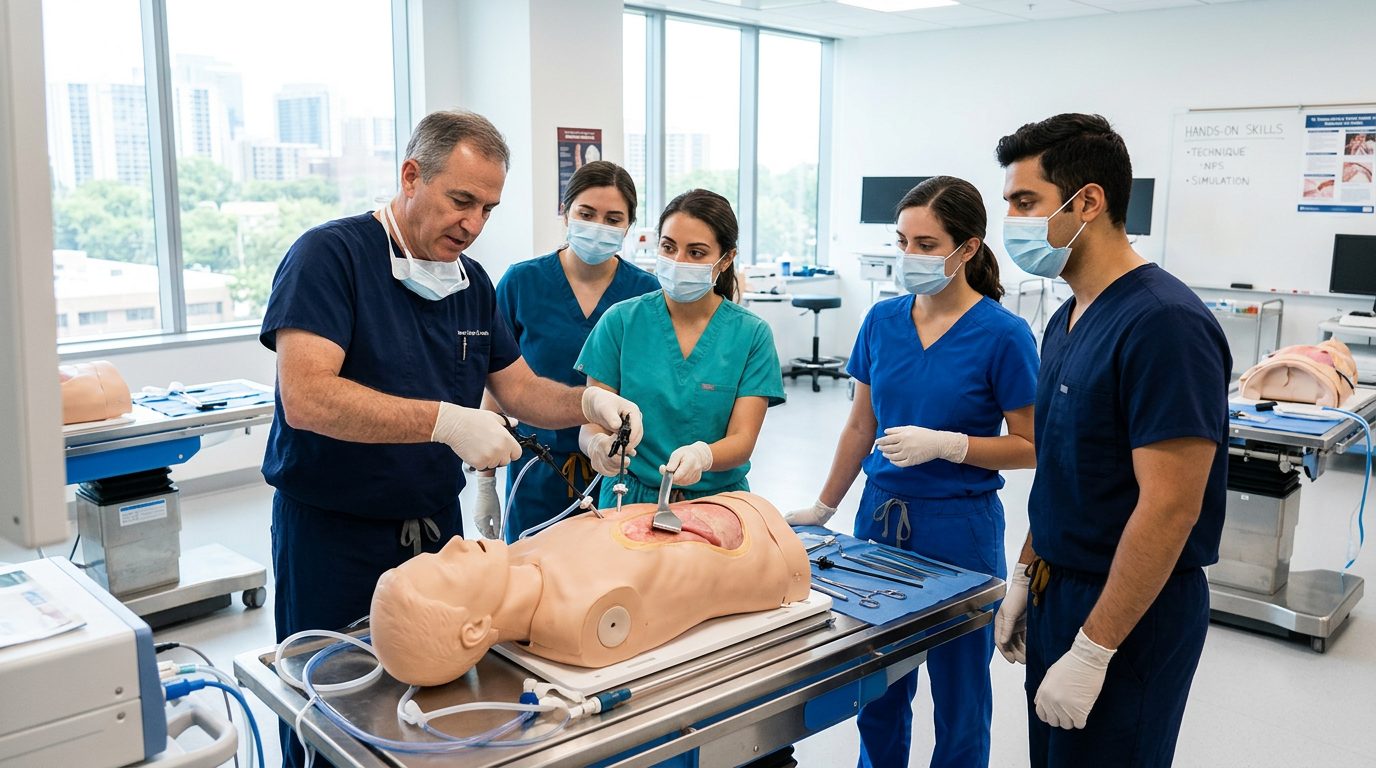
If a programme includes practical components, those components should be explicitly defined and delivered in an appropriate educational environment, such as simulation, demonstration or another supervised format allowed by the host institution.
Define the learning objective before choosing the institution
The strongest observerships begin with a specific question. “I want to see cardiology” is too broad. A better objective might be to understand the workflow of a catheter laboratory, observe multidisciplinary decision-making for complex cases, study post-operative rehabilitation pathways or review how a department organises quality and safety processes.
For a nursing group, the focus might be critical-care workflow, infection prevention, patient education or oncology nursing. For a hospital administrator, the observership may centre on patient flow, digital systems, procurement or international patient services.
Individual versus group observerships
Individual programmes can be highly focused and are often easier to adapt around a particular specialty. Group programmes, however, can create wider institutional impact when participants return to the same organisation and are expected to implement lessons together.
Large groups require more careful design. A department that can accommodate one observer safely may not be able to host fifteen people in the same clinical space. Splitting participants into smaller streams or combining observation with classroom sessions can improve the educational experience.
Documents and professional information
Host institutions may request a curriculum vitae, passport copy, professional registration information, degree or specialty documents, vaccination or occupational health records, a statement of objectives and proof of employment. Requirements differ, so participants should not assume one document list applies everywhere.
Applications should be submitted early enough for institutional review. Last-minute requests can be difficult, especially when access to clinical areas requires internal approvals.
Patient privacy and professional conduct
Observerships take place in environments where patient confidentiality must be protected. Participants should expect restrictions on photography, recording and the use of patient information. A clinical case discussed for educational purposes remains confidential.
Observers should follow the host institution’s dress code, identification requirements, infection-control measures and behavioural standards. If a participant is uncertain whether an activity is allowed, the correct approach is to ask the programme supervisor before proceeding.
Building a useful daily programme
A well-structured observership should have rhythm and purpose. A typical day might include a briefing, clinical observation, a case discussion or academic meeting, and a short debrief at the end. The debrief is important because it turns passive observation into structured learning.
For longer programmes, participants can keep a reflective learning log. Institutions sponsoring a group may ask for a final presentation or report focusing on practices that could be adapted to the home organisation.
Certificates: be precise about what they mean
A certificate should accurately state participation in an observership or educational programme. It should not imply a professional qualification, licence or competency assessment unless the programme genuinely includes those elements and the issuing institution is authorised to certify them.
Clear wording protects both the participant and the host institution and helps sponsors understand the educational outcome.
Medical information notice
This article is for general information and does not replace individual medical advice, diagnosis or treatment. Medical decisions should be made by appropriately qualified healthcare professionals after reviewing the individual patient.
Your next step
To request an observership, send the participant’s specialty, professional level, area of interest, preferred dates, desired duration and specific learning objectives. Institutional group requests should also include the number and profile of participants.
Get a free consultationEditorial references
- CDC Yellow Book — Study Abroad and Other International Student Travel (occupational exposure considerations for medical and nursing learners).